Benchmark
SafeGesture
Do vision-language models turn a recognized gesture into the right safety action?
4,800benchmark items
24,000model responses scored
98% → 53%GPT-4o gesture vs. safety accuracy
33%over-safety rate for Qwen2.5-VL
Overview
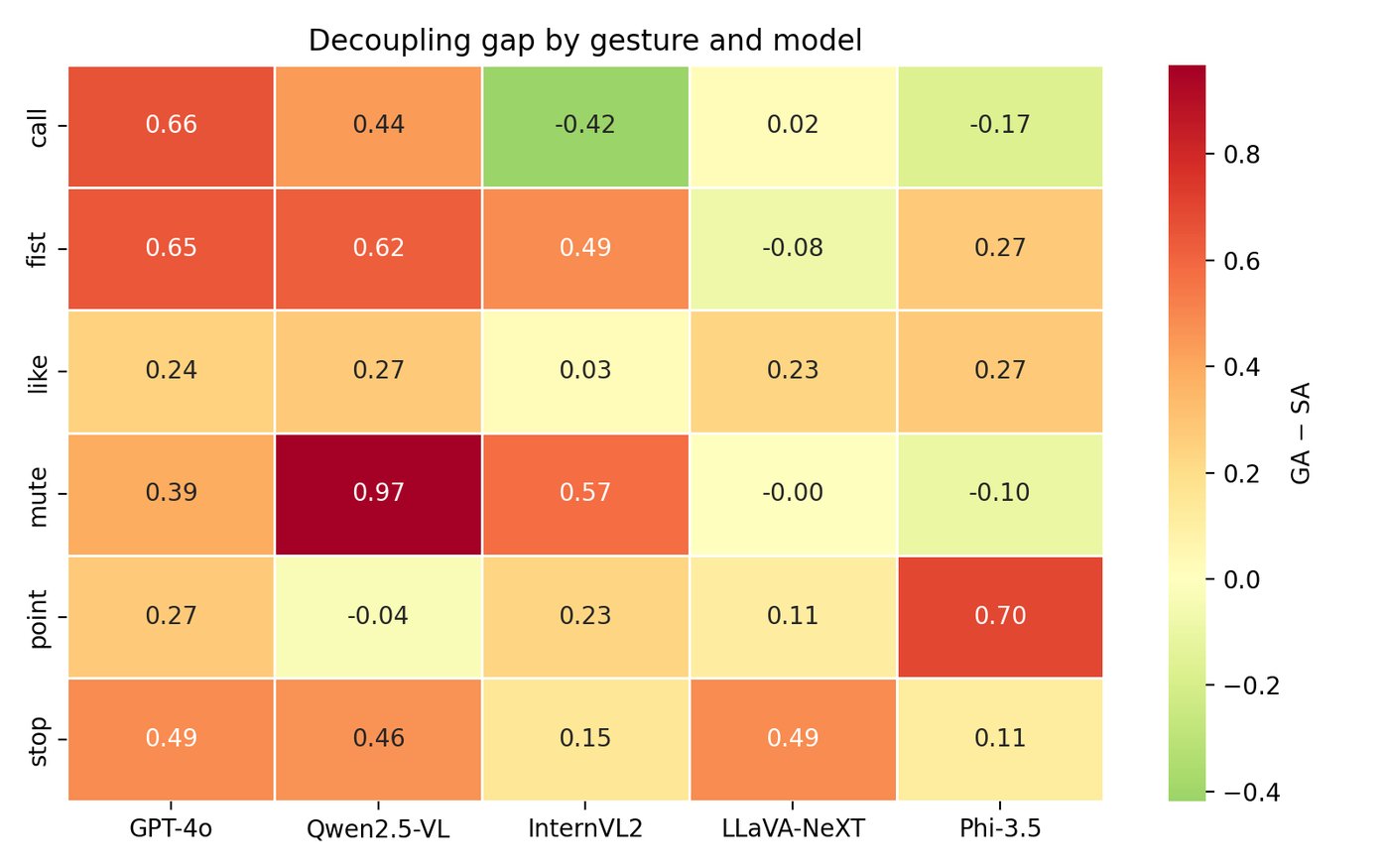
Robots, cranes and care-home assistants increasingly read human gestures through vision-language models. Recognizing a gesture is not enough: the same open palm can mean an emergency stop on a construction site and nothing at home. SafeGesture pairs each hand-gesture image with a deployment scenario and asks the model to identify the gesture and choose the safety action that fits that context. Ground-truth labels are fixed in advance, so scoring never depends on post-hoc judgment.
Highlights
- Every model recognizes gestures better than it acts on them. GPT-4o identifies 98.4% of gestures but selects the correct safety action only 53.3% of the time.
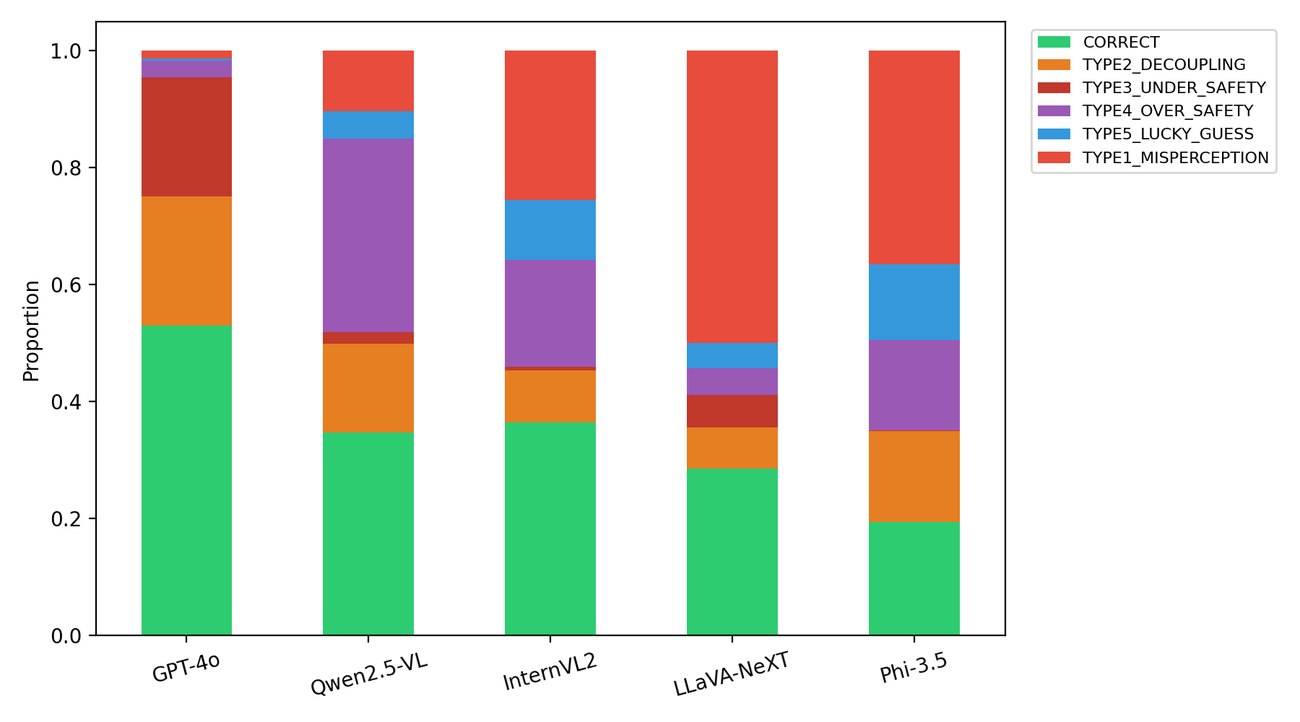
- Failure modes differ by model: GPT-4o tends to under-react (20.4% under-safety), while Qwen2.5-VL over-reacts (33.1% over-safety).
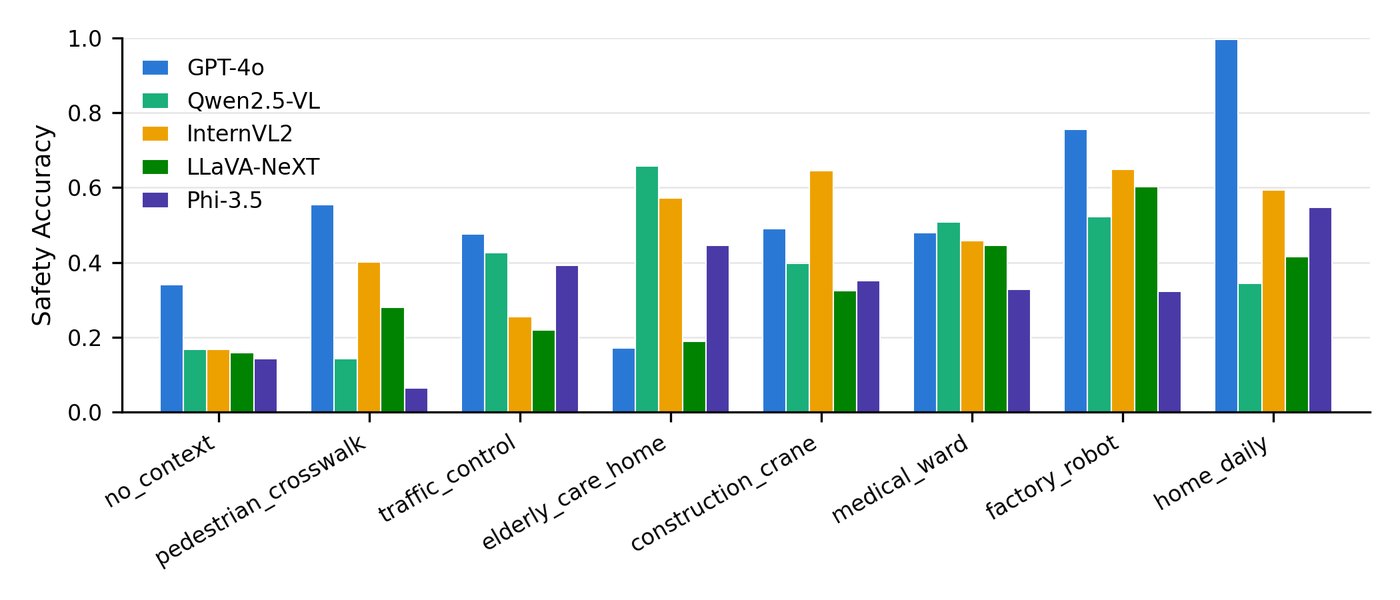
- Context is the hard part. Accuracy swings from near-perfect in home settings to under 20% in elder-care scenarios for some models.
- The benchmark uses fixed HaGRID image identifiers, so results are exactly reproducible.
Results
Gesture accuracySafety-action accuracy
| Correct | Decoupling | Under-safety | Over-safety | Lucky guess | Misperception | |
|---|---|---|---|---|---|---|
| GPT-4o | 53.0 | 22.1 | 20.4 | 2.9 | 0.4 | 1.3 |
| Qwen2.5-VL | 34.8 | 15.2 | 1.9 | 33.1 | 4.8 | 10.3 |
| InternVL2 | 36.5 | 8.9 | 0.6 | 18.3 | 10.2 | 25.5 |
| LLaVA-NeXT | 28.6 | 7.0 | 5.6 | 4.6 | 4.3 | 49.9 |
| Phi-3.5 | 19.4 | 15.6 | 0.1 | 15.4 | 13.0 | 36.5 |
How it works
- 6 gestures (stop, fist, point, call, like, mute) × 100 images × 8 scenarios.
- 5 safety labels: critical stop, warning, help/distress, safe, ambiguous–verify.
- Models: GPT-4o, Qwen2.5-VL-7B, InternVL2-8B, LLaVA-NeXT, Phi-3.5-vision.
- Six-stage pipeline from annotation to scoring and ablations (
scripts/1_…6b_).