Safe by Benchmark, Unsafe in Practice
Lessons from 1,331 child-related AI incidents
Overview
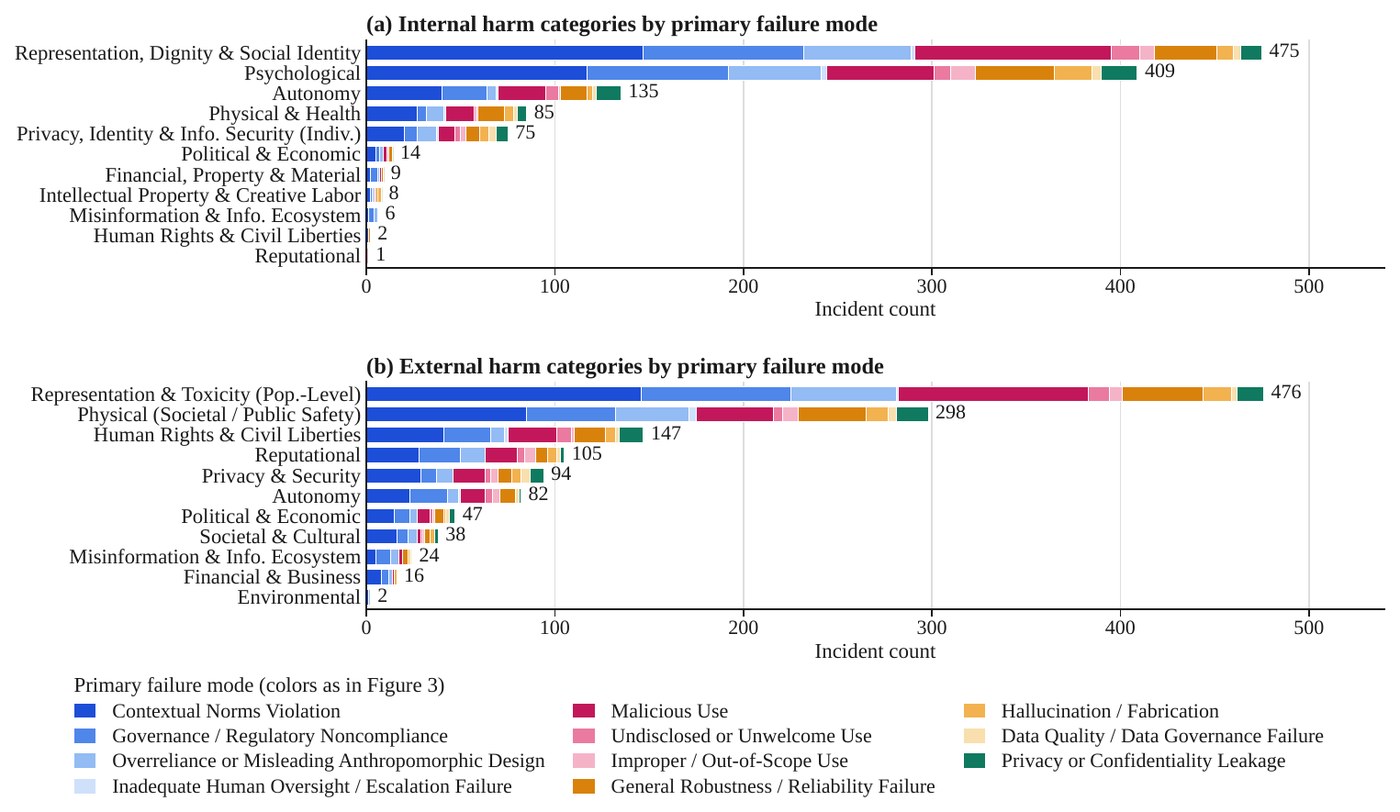
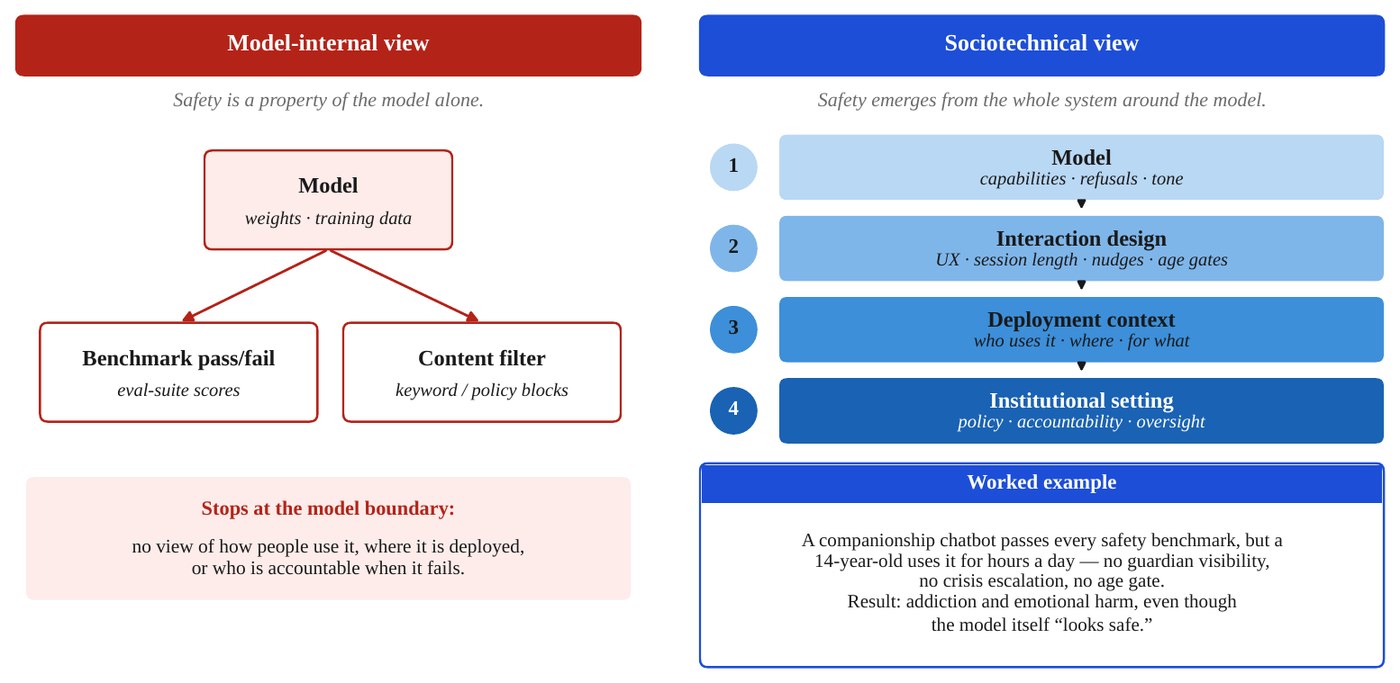
Child safety in AI is usually judged at the model level, through benchmarks, red-teaming and content filters. This project asks what actually goes wrong once these systems reach children. We built KidAID, a corpus of 1,331 publicly reported incidents in which a minor experienced harm or a credible worst-case risk, drawn from the OECD.AI incident monitor, AIAAIC and the AI Incident Database. Each incident is coded with a child-specific internal (individual-level) harm, an external (population-level) harm, and the sociotechnical failure mode most directly implicated, using a new child-centered taxonomy.
Highlights
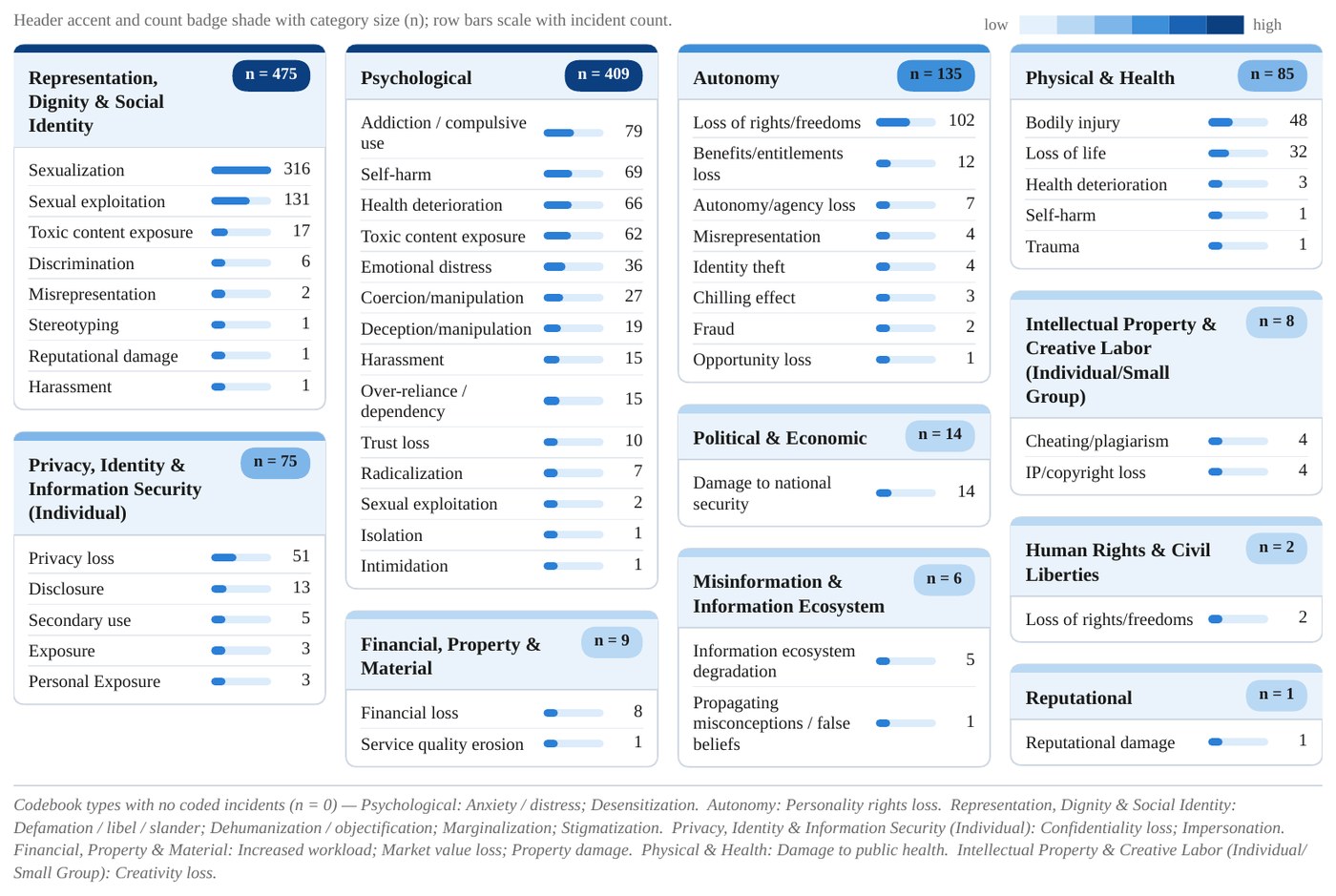
- Harms concentrate in representational, dignity-related and psychological categories, led by sexualization (316), sexual exploitation (131), addiction / compulsive use (79) and self-harm (69).
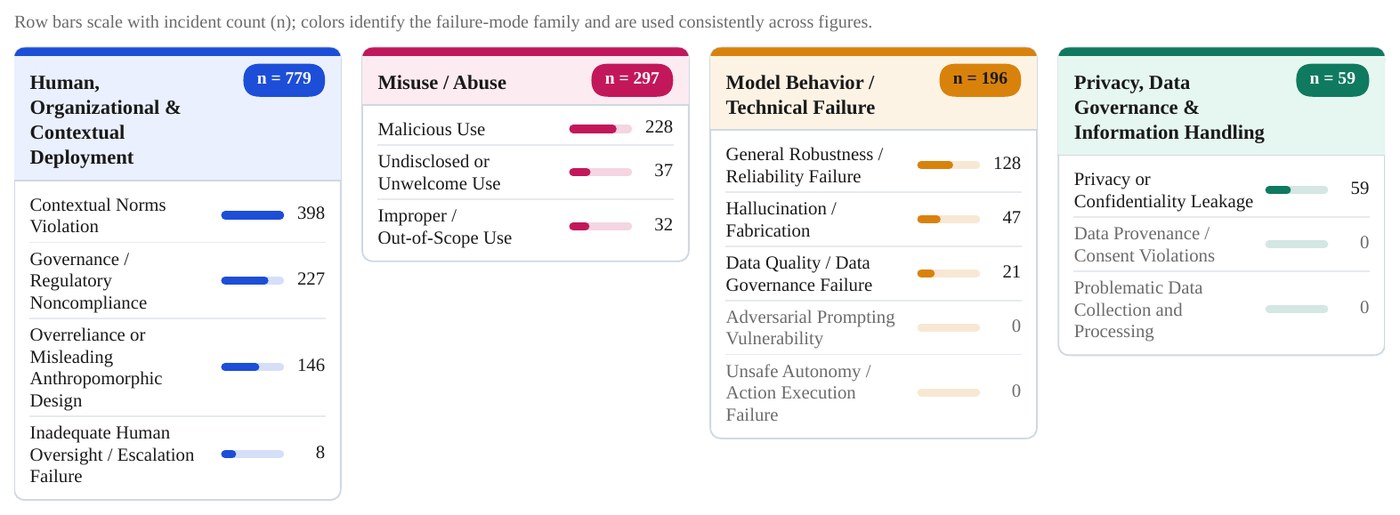
- Most failures are sociotechnical, not model defects: deployment and organizational failures (779) and misuse (297) far outnumber technical model failures (196).
- Harm to one child often spreads to the population level. AI-generated images of a single student, for example, can circulate through an entire school.
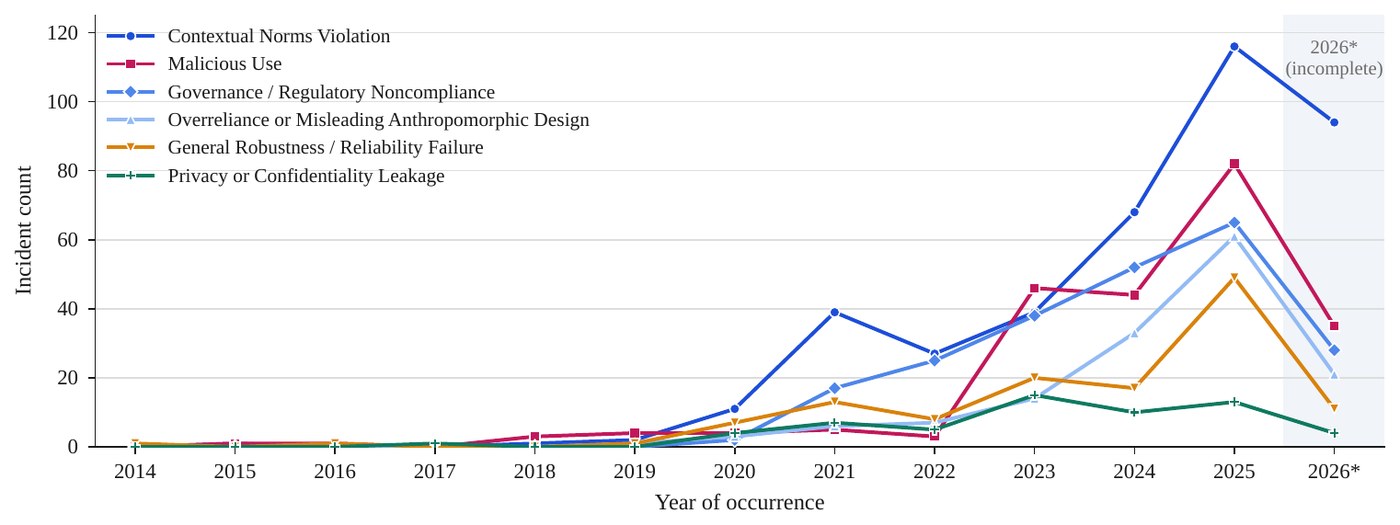
- Reported incidents were flat through the mid-2010s, rose sharply around 2020 and accelerated after 2022, with contextual norms violation becoming the leading failure mode.
- Model-level evaluations are necessary but cannot anticipate these pathways alone. The paper recommends age assurance, content verification, safety-by-design UX, incident disclosure norms and audits targeting developmental risk.
Results
Method
- Inclusion: AI is materially involved, at least one affected stakeholder is under 18, and the report supports coding a harm and a failure mode.
- Dual-level harm coding links what happened to the child with the wider population-level harm.
- Codebook developed iteratively; reliability checked on 150 double-coded incidents (Krippendorff's α = 0.73 for harm categories, 0.67 for failure modes).
- Findings are descriptive counts of reported incidents, not causal estimates.
Resources
Citation
Jiao, J., Chen, K., Mishra, S., Murali, A., Atkinson, D., Raj, S., & Afroogh, S. (2026). Safe by benchmark, unsafe in practice: Lessons from 1331 child-related AI incidents. arXiv preprint arXiv:2610.34705.