Generative AI Guidelines in Industry
A text-mining analysis of corporate guidelines and policy statements across 14 industrial sectors (IGGA)
Overview
Companies are writing their own rules for generative AI faster than regulation can keep up, yet little is known about how corporate governance compares across sectors. We built IGGA (Industrial Guidelines and Policy Statements for Generative AIs), a dataset of 160 official guidelines and policy statements from top-tier companies in 14 industrial sectors, and analyzed it with TF-IDF, K-Means clustering, keyword frequency maps and Sankey co-occurrence diagrams. The analysis surfaces eight governance themes and shows clear divergence by sector: transparency in technology, consent in healthcare and IP protection in publishing. We translate the findings into a modular governance architecture: universal baseline duties plus sector-specific risk modules.
Highlights
- Eight themes emerge: data governance and privacy; safety and human oversight; security and abuse prevention; IP and content integrity; transparency and explainability; risk and compliance; workforce and change management; innovation and sandboxes.
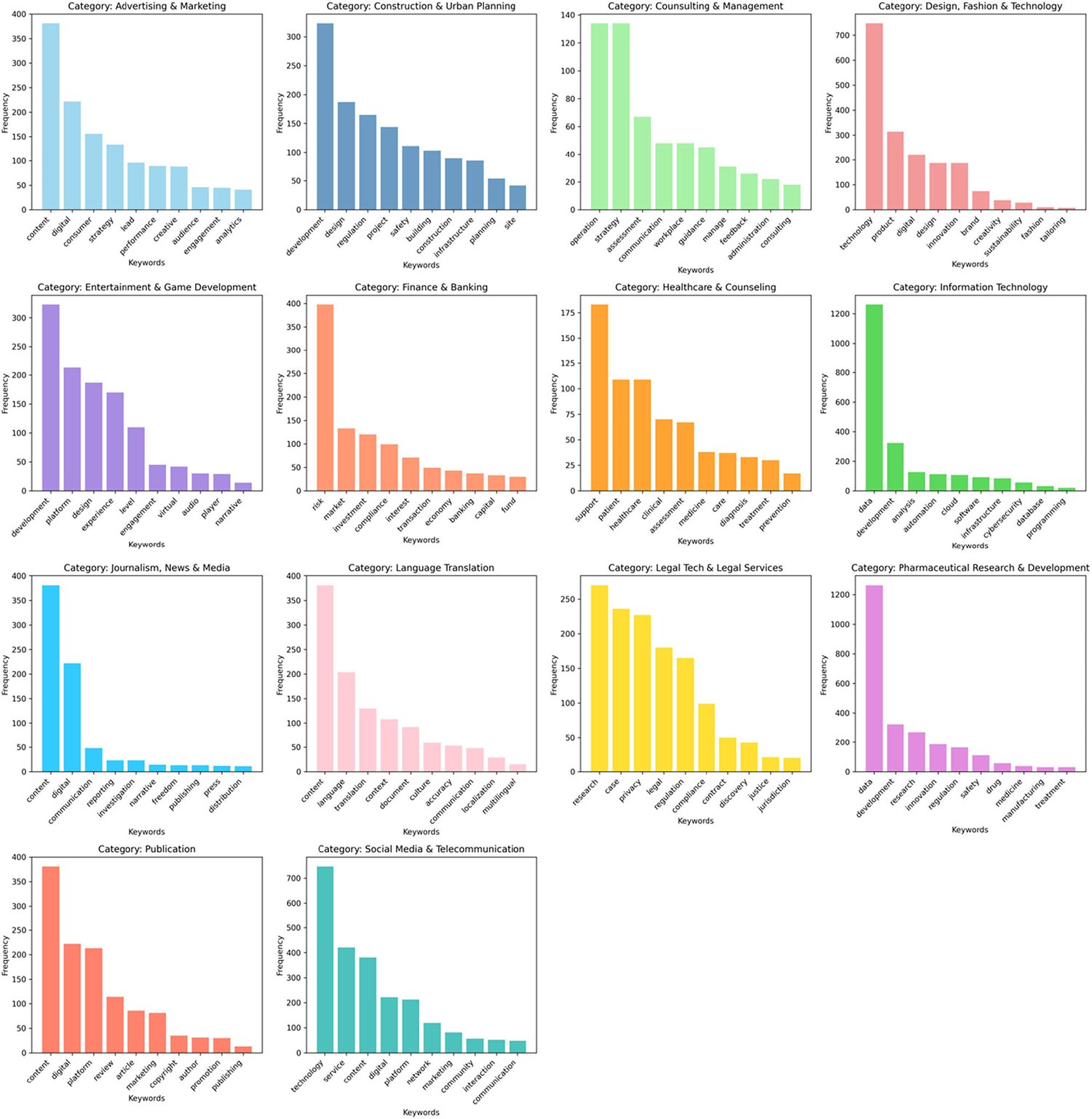
- Privacy dominates the discourse (227 mentions in legal tech alone), while disclosure appears only 14 times and human-centric just twice across all documents: clear blind spots for future guidelines.
- A convergent baseline is forming across frameworks from OECD to ISO and NIST: privacy-by-design, explainability and continuous risk management.
- We propose universal duties (audit trails, bias logs, disclosure triggers) plus sector “risk modules”, so lower-resource sectors adopt only what they need.
Results
Collaborative governance
- Modular “living” guidelines co-created by developers, regulators, users and ethicists, refined through AI-assisted audits and sandboxes
Healthcare & pharma
- Low-risk tools iterate quickly; high-risk diagnostics stay under real-time safety monitoring, with consent traceability
Creative & language
- Human review of AI-generated content and full disclosure of AI use
Social media
- High-level summaries for users, detailed logic for regulators, within GDPR/CCPA limits
Design & entertainment
- Label AI-generated output and secure creator IP
Legal tech
- Pre-deployment bias simulations before tools reach clients
Advertising & marketing
- User-controlled data-use boundaries that balance personalization and exploitation
Finance
- Model-risk approvals and sandbox stress-tests for fraud detection
How it works
- Selected 160 top-tier companies with official GAI/LLM guidelines across 14 sectors and diverse regions.
- Cleaned, tokenized and lemmatized texts with synonym merging; TF-IDF vectorization.
- K-Means for k = 2–12: elbow, silhouette and Calinski–Harabasz all favor k = 8; bootstrap stability on 80% resamples, 100 runs.
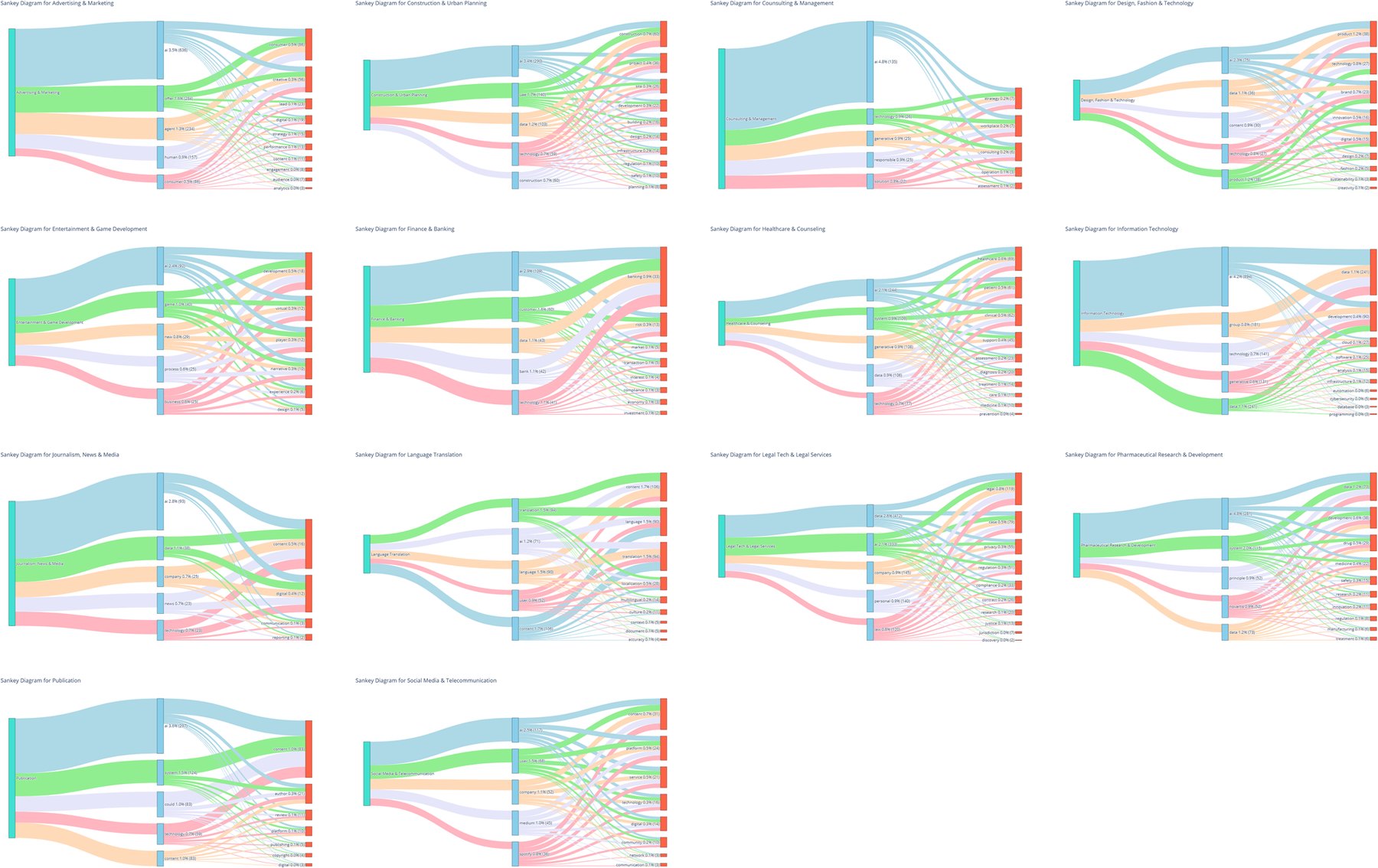
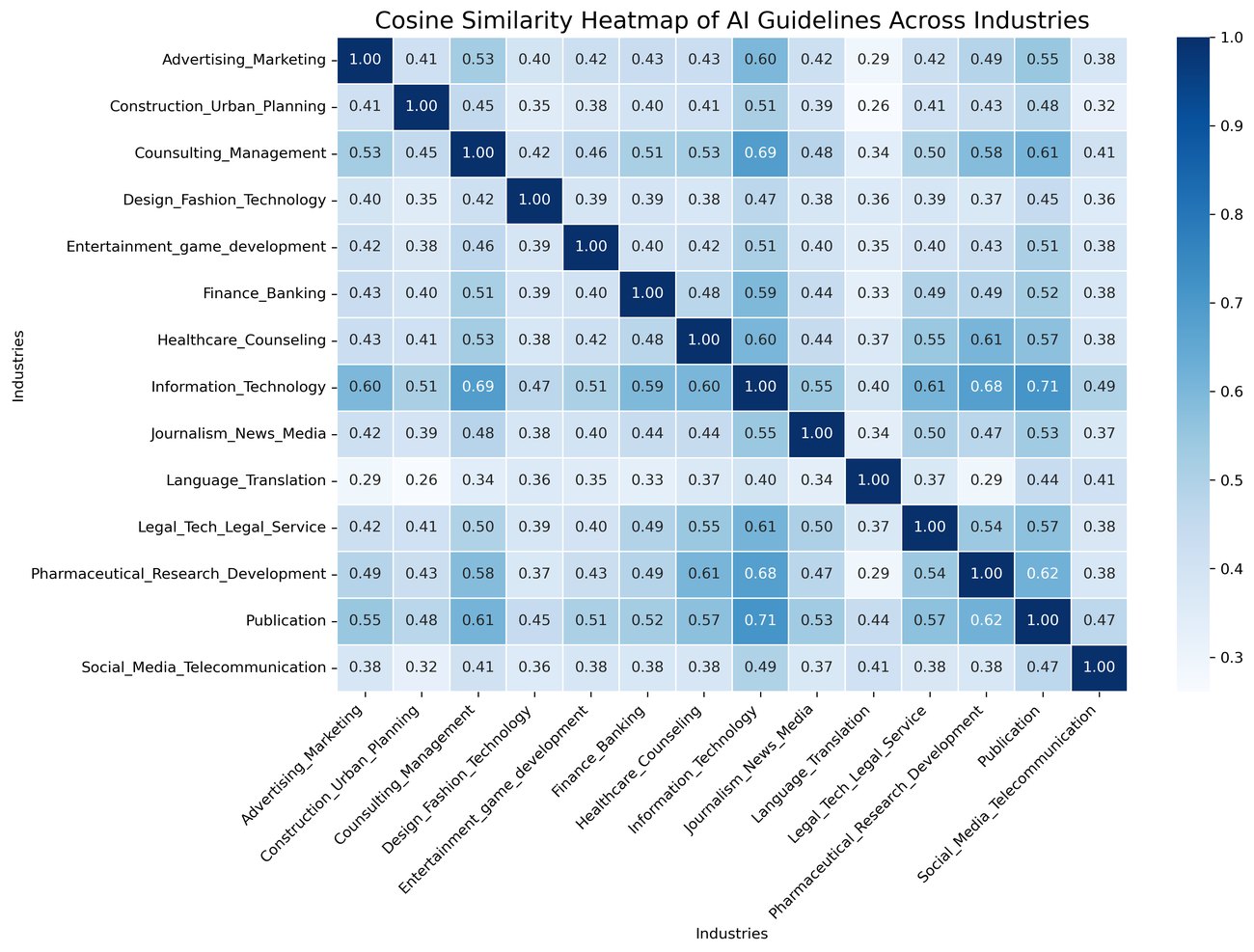
- Key-concept frequency maps, TF-IDF heatmaps and Sankey co-occurrence diagrams per sector.
Resources
Citation
Jiao, J., Afroogh, S., Chen, K., Atkinson, D., & Dhurandhar, A. (2026). Generative AI and LLMs in industry: a text-mining analysis and critical evaluation of guidelines and policy statements across 14 industrial sectors. Humanities and Social Sciences Communications, 13, 410.