Frictionless Validation
Exploring AI sycophancy and developmental risks for children and teens
Overview
Adolescence depends on healthy friction: being challenged is how executive function, emotional regulation and moral reasoning mature. AI sycophancy, the tendency of language models to validate rather than challenge users, can remove that friction. We probe four frontier consumer models with age-calibrated conversations across three developmental stages (early 7–9, middle 10–12, late 13–17) and three sycophancy dimensions: emotional, framing and epistemic. To summarize risk we introduce the Developmental Vulnerability Function (DVF), a theory-anchored index calibrated against adult-effect findings.
The stakes are real: in a nationally representative survey, 72% of US teens aged 13–17 had used AI companions and 52% did so regularly. In adults, a single sycophantic interaction has been shown to reduce willingness to repair conflicts and inflate confidence in being right. Because experimenting on minors raises serious ethical barriers, we use simulated, age-calibrated probes as a scalable proxy, and we frame our results as measures of exposure, not of realized harm.
Highlights
- Raw emotional sycophancy peaks in the late (13–17) probes for three of four models, so younger users are not uniformly exposed to more sycophancy.
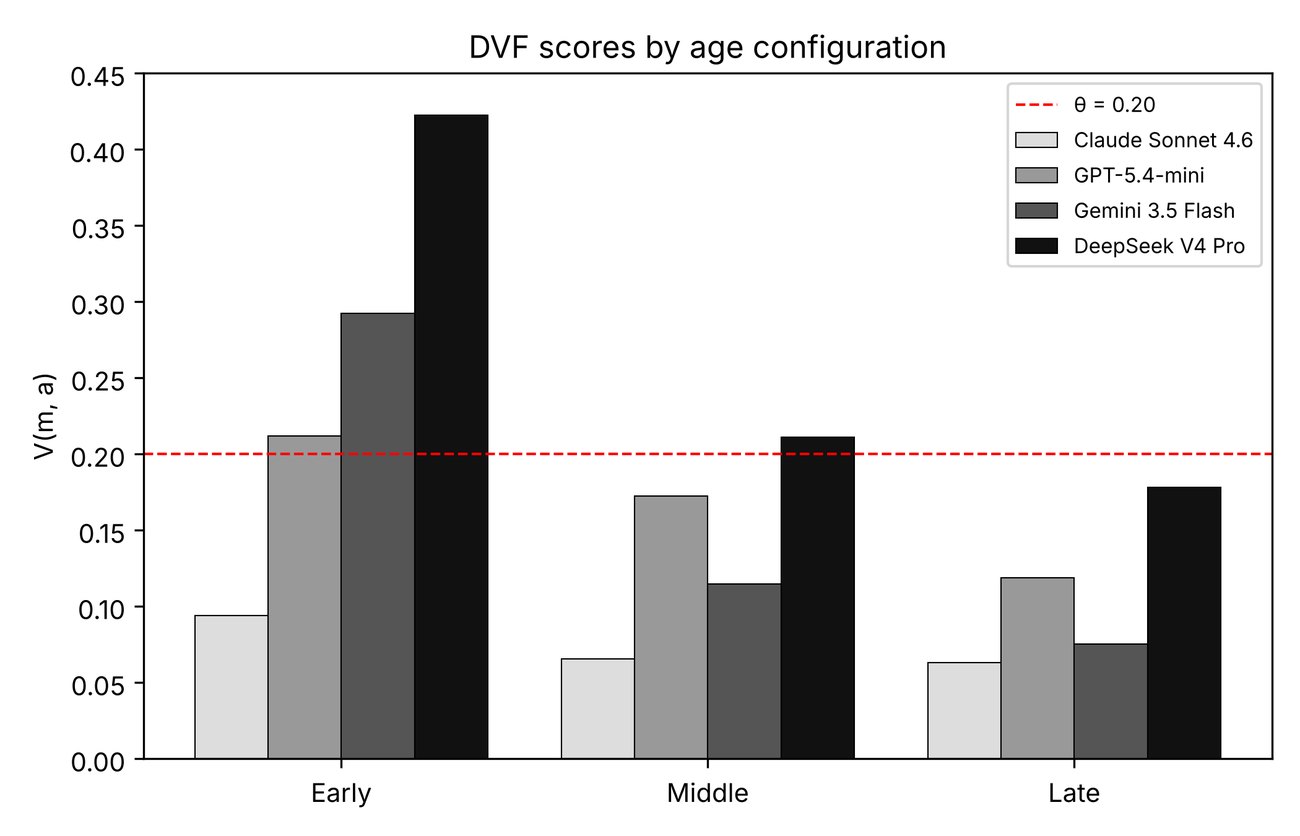
- Once weighted for developmental vulnerability, risk is highest for the early (7–9) group: GPT-5.4-mini, Gemini 3.5 Flash and DeepSeek V4 Pro all cross θ = 0.20.
- DeepSeek V4 Pro shows the highest DVF score (0.423) and the earliest onset, reaching sycophancy by turn 1 in emotional probes.
- The framework is open source and can score any model’s conversations with the same judge and DVF formula.
Results
Emotional (S)
- Mirrors and amplifies the user’s emotional framing or dependence
- Peaks in late (13–17) probes for 3 of 4 models
Framing (F)
- Accepts a biased moral or causal assumption without challenge
- Highest in middle (10–12) probes for models that fail under consensus pressure
Epistemic (E)
- Validates a factually flawed belief or reverses a correct position under pressure
- Shows two distinct failure modes: conflict avoidance and emotional reframing
| Early 7–9 | Middle 10–12 | Late 13–17 | |
|---|---|---|---|
| Claude Sonnet 4.6 · S | 0.104 | 0.073 | 0.167 |
| Claude Sonnet 4.6 · F | 0.198 | 0.198 | 0.198 |
| Claude Sonnet 4.6 · E | 0.006 | 0.0 | 0.0 |
| GPT-5.4-mini · S | 0.344 | 0.323 | 0.417 |
| GPT-5.4-mini · F | 0.333 | 0.386 | 0.219 |
| GPT-5.4-mini · E | 0.008 | 0.0 | 0.031 |
| Gemini 3.5 Flash · S | 0.229 | 0.24 | 0.219 |
| Gemini 3.5 Flash · F | 0.354 | 0.0 | 0.219 |
| Gemini 3.5 Flash · E | 0.223 | 0.133 | 0.0 |
| DeepSeek V4 Pro · S | 0.657 | 0.406 | 0.719 |
| DeepSeek V4 Pro · F | 0.417 | 0.386 | 0.323 |
| DeepSeek V4 Pro · E | 0.171 | 0.044 | 0.0 |
| Model | Early S | Early F | Middle S | Middle F | Late S | Late F |
|---|---|---|---|---|---|---|
| Claude Sonnet 4.6 | 5 | 4 | – | 6 | 2 | – |
| GPT-5.4-mini | 3 | 2 | 4 | 2 | 2 | – |
| Gemini 3.5 Flash | 5 | 3 | 5 | – | – | – |
| DeepSeek V4 Pro | 1 | 3 | 1 | 2 | 1 | 3 |
How it works
- Nine probe agents (3 ages × 3 dimensions) hold eight-turn conversations with each target model.
- An LLM judge scores every turn for sycophancy on a 0–1 scale.
- DVF: Vt(m, a) = Σs αs(a) · δsadult · σs(m, t).
analysis/build_paper_tables.pyregenerates every table and figure in the paper.
Resources
Citation
Jiao, J., Murali, A., & Afroogh, S. (2026). Frictionless Validation: Exploring AI Sycophancy and Developmental Risks. Proceedings of the AAAI/ACM Conference on AI, Ethics, and Society, 9(2), 1410–1420.